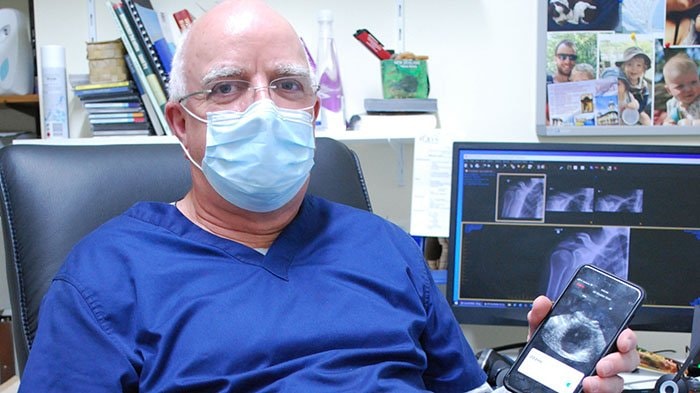
Point of care ultrasound (POCUS) was rolled out to 29 rural GP practices across the Pinnacle network in September, with overwhelmingly positive feedback from clinicians.
POCUS involves the use of a handheld ultrasound device as a diagnostic tool in primary care, an approach increasingly used worldwide by doctors in rural general practice and emergency care. The recent emergence of smaller, more affordable ultrasound technology provided Pinnacle with the opportunity to fund the use of Butterfly IQ ultrasound devices in rural practices as part of its rural strategy to invest in technologies that enhance services for patients.
“POCUS is a tool that allows for more complete patient assessment at the point of care,” says Tony Mottershead, general manager primary care strategic development. “It empowers GPs to make more informed decisions in the usual course of their day, ultimately improving clinical decision-making.”
The technology is particularly useful for more accurate diagnosis of conditions seen fairly often in general practice such as deep venous thrombosis (DVT), gallstones, aortic aneurysms, bladder distension, hydronephrosis and fluid in the lungs or abdomen where it shouldn’t be.
“It’s the stethoscope of the future, but it’s here now,” says Dr Jo Scott-Jones, medical director. “POCUS will give rural patients a more accurate and rapid understanding of what’s happening to them, and in some instances will offer an opportunity for care closer to home, reducing the need for travel to specialist appointments.”
Tony and Jo are quick to emphasise that POCUS is not a replacement for the services of a specialist sonographer, with the years of training and experience they offer. Rather, it’s a diagnostic tool that GPs can use in the usual course of their day, which may reduce demand on the already pressured referral system. If there is any uncertainty, clinicians are encouraged to be cautious and refer patients for further assessment, as usual.
Training to develop scanning techniques and knowledge is being provided to the rural clinicians using POCUS. An introductory online training module is followed by a weekend workshop with both theoretical and practical hands-on training, provided by New Zealand-based Ultrasound Imaging and Education (UIE).
Mottershead says a training weekend in the Waikato in mid-September exceeded expectations. “A few GPs expressed doubt about the investment in POCUS over other technologies, but by the end of the training weekend they had a totally different view. They could see it was going to be an extremely valuable investment in their practice, with a broad clinical application.”
Ongoing training will also be provided to support skill development and help keep POCUS in regular use in the practices. “As with any new skill, quality assurance and improving clinician confidence requires training, effort, time and patience,” says Scott-Jones.
“We know that minimal training results in minimal use of the machines. Understanding how POCUS can fit in the flow of a normal patient consultation is important – recognising when it will be valuable and working out the practicalities of having the machine turned on and ready to use.”
Dr Michael Miller, who has been using ultrasound in his Whangamatā general practice for over 10 years, says he is totally in support of the POCUS rural initiative. “It’s incredibly important and very useful for improving diagnostic certainty,” says Dr Miller. “I use POCUS all the time with the majority of my patients, to answer specific clinical questions. It reduces emergency department presentations and means we can make more specific referrals.”
Feedback from the practices involved so far has also been universally positive, as they recognise the opportunities the technology provides for them and their patients. Demand for training is high, and Pinnacle is looking to widen it further and repeat training sessions to reach all rural clinicians using POCUS, including nurse practitioners.
A New Zealand clinician POCUS peer group, led by Dr Miller, is being established to provide support and training. The peer group will allow clinicians to share ongoing learning and review the use of POCUS in general practice, with a view to including urban practices that decide to invest in the technology in future.